Market trends · 26 Oct 2026 · 10 min read
Brands vs own label: which categories can carry the price gap
Own label holds half or more of grocery units in the UK, Germany and Spain, and brands defend the value gap with promotion. Our benchmark follows the shelf, the winners and what it means for a website.
BE VISIBLE Studio · Website studio
In short
- Own label holds half or more of grocery units in the UK, Germany and Spain (52–59%), yet 7–8 points less of value.
- Brands defend that value gap mainly through price and promotion: 34% of branded sales are on promotion, against 14% for own label.
- On Tesco's online shelf in the report's audit, every sponsored listing was a brand, brands led on reviews, and own label led on unit price.
- For a website, the report points to provable product facts, visible unit prices, reviews and independent proof, not generic quality claims.
- The share evidence is strong, the shelf-price evidence is a pilot, and the report is built from 136 graded sources dated October 2026.
On 8 October 2026, a 415g can of Heinz baked beans on Tesco's website cost £1.40. Tesco's own 420g can cost £0.39, and the retailer's value label, Stockwell & Co, sold a can for £0.28. Per kilogram the brand cost £3.37 and the value can £0.67, five times less. That three-way shelf, captured in our Brands vs Own Label benchmark, is the grocery trade in miniature: shoppers who have learned to buy the cheaper can, and brands trying to hold a price that is several times higher.
Own-label now holds half or more of grocery units in the UK, Germany and Spain (52–59%), yet 7–8 points less of value. Brands defend that value gap mainly through price and promotion: 34% of branded sales are on promotion against 14% for own-label. So the decision is which categories can carry a 1.5x–4x unit-price gap, not when share will return to brands.
Brands vs Own Label benchmark, executive summary
The study is dated October 2026 and covers the United Kingdom in depth, with France, Spain, Germany and the United States as lighter comparisons. It is desk research with no interviews, and it is candid about its evidence: "This is a sector benchmark with no client. The share evidence is strong, but the shelf-price and channel evidence is still a pilot."
Half of the units, less of the value
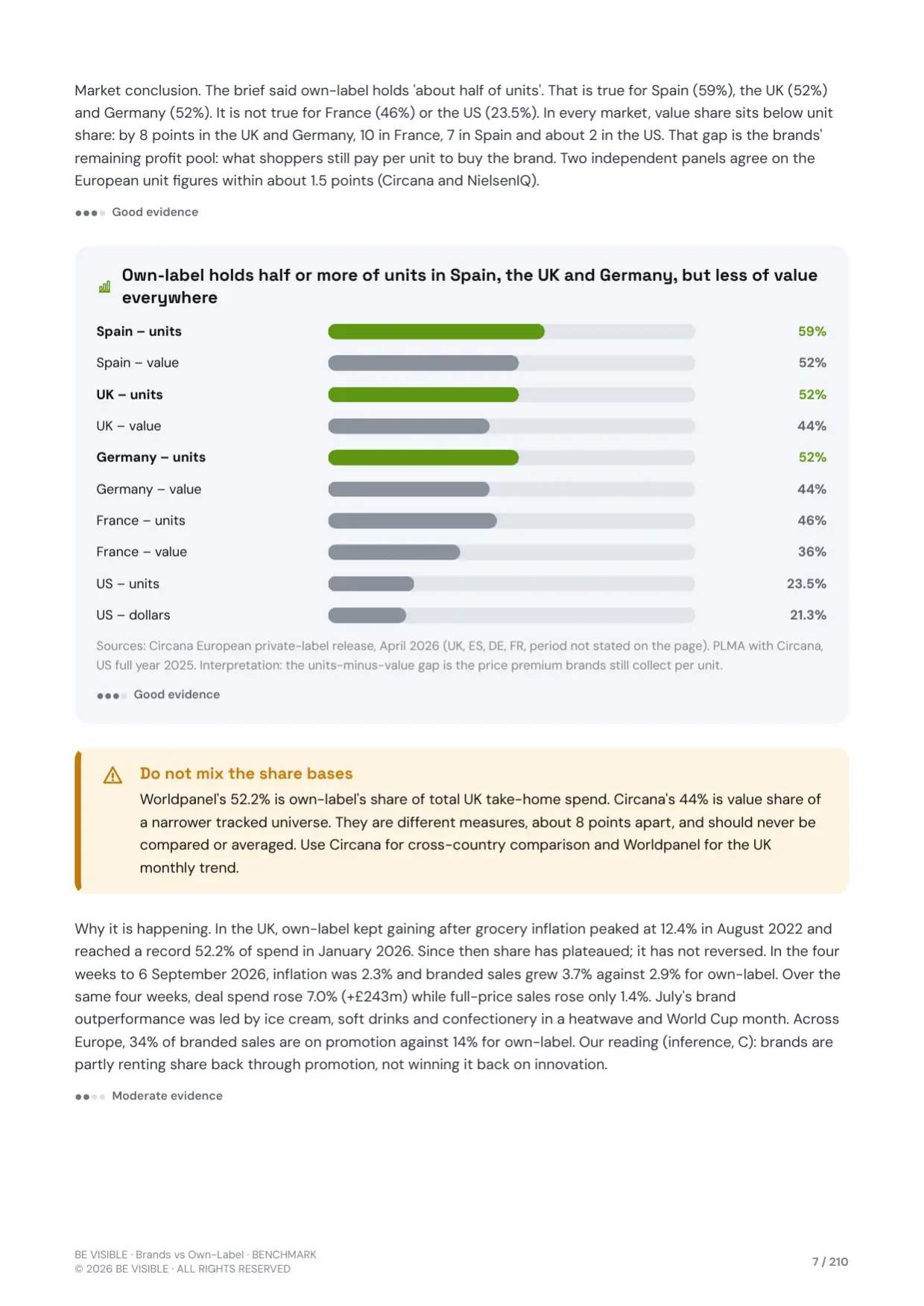
Start with a definition problem. The report notes that own-label share is three different numbers, and picking the wrong one moves the UK answer by eight points. Circana's April 2026 release puts own label at 52% of UK units and 44% of value. Worldpanel puts it at a record 52.2% of total take-home spend in the four weeks to 25 January 2026, a different measure, in a month Worldpanel itself calls seasonally high for own label. The report says the two should never be averaged.
Across countries, the 'half of units' claim holds in Spain, the UK and Germany and fails in France and the US. In every market value share sits below unit share: by eight points in the UK and Germany, ten in France, seven in Spain and about two in the US. The report reads that gap as the brands' remaining profit pool, what shoppers still pay per unit to buy the brand. Circana and NielsenIQ agree on the European unit figures within about 1.5 points.
Spain
59%
52% of value
UK
52%
44% of value
Germany
52%
44% of value
France
46%
36% of value
US
23.5%
21.3% of dollars
Source: Circana European private-label release (April 2026) and PLMA with Circana (US, 2025), as reported in the Brands vs Own Label benchmark (confidence B).
The UK story is a plateau, not a reversal. Own label kept gaining after grocery inflation peaked at 12.4% in August 2022 and reached its record in January 2026. In the four weeks to 6 September 2026, with inflation at 2.3%, branded sales grew 3.7% against 2.9% for own label. But deal spend rose 7.0% (+£243m) while full-price sales rose only 1.4%. The report's reading, graded C and labelled inference, is that brands are partly renting share back through promotion rather than winning it back on innovation.
What is driving the shift
Shoppers have stopped waiting for brands to come back. In a Harris Poll UK survey of 1,000 adults from May 2026, 83% said own label had improved significantly and only 41% said brands give better value, although 64% still rate brands higher on quality and 59% as more consistent. A Pricer survey from June 2024, which the report grades C because it is a vendor survey of stated intent, found 63% of UK shoppers had switched to own label in the previous 12 months and only 6% would go back to brands for the whole shop.
Own label has improved significantly
83% agreeing
Brands are higher quality
64% agreeing
Brands are more consistent
59% agreeing
Brands taste better
57% agreeing
Brands offer better value
41% agreeing
Source: Harris Poll UK, 1,000 adults, May 2026, as reported in the Brands vs Own Label benchmark (confidence C).
The pressure now comes from above. Aldi's Specially Selected range reached £1.6bn, up 11%. Lidl's Deluxe grew 12% in the year to February 2026. Premium own label passed £1bn in a single month for the first time in December 2025, at 7.5% of take-home sales. The report notes that premium own label's +10.3% is a 2025 reading, with no 2026 panel growth rate published.
Retailers also copy fast: Asda, Sainsbury's and Morrisons launched protein ranges in January 2026, so a plain protein claim is now table stakes. GLP-1 weight-loss drugs add a second squeeze: 6.3% of Great Britain's households now include a user, up from 2.3% in 2024, and users report cutting chocolate (75%) and crisps (72%), the treat categories where brands hold best.
Where brands hold depends on how visible the difference is. In treats, 35% of UK shoppers mostly buy branded and 76% say they could tell the difference blind, against only 17% mostly buying branded in ambient staples. Heinz shows the cost of misjudging the gap: after a 37.8% price rise its beans lost 24.3% of volume, according to Kantar data reported in 2023.
Who is winning, and how
The report's blunt reading is that a brand's main competitor is the retailer that stocks it. Tesco's beans shelf is the clearest ladder in the data.
01
Value own label
Stockwell & Co 420g, £0.28, £0.67 per kg, flagged Aldi Price Match.
02
Standard own label
Tesco 420g, £0.39, £0.93 per kg.
03
Challenger brand
Branston 410g, £1.00, £2.44 per kg, with an 85p Clubcard Price.
04
Leading brand
Heinz 415g, £1.40, £3.37 per kg, or any 2 for £2.
Source: Tesco website, as reported in the Brands vs Own Label benchmark (confidence A for the observations; the report says to read them as true for that pack, retailer and day).
Each retailer uses the ladder differently. Lidl GB is the only discounter still gaining, at 8.7% share against 8.3% a year earlier, with sales up 8.0% against Aldi's 0.7%. Tesco holds 27.8% of the market and matches Aldi on over 600 lines, Sainsbury's matches on 400 products, and Morrisons replaced its own on 23 August 2026 with 'Unbeatable Prices' on 500+ staples. Morrisons also rents a real brand, under a three-year exclusive licence with Applied Nutrition.
Brand owners are buying volume back with price. Unilever reported underlying volume growth of 4.2% in the first half of 2026 and PepsiCo cut US prices on Lay's, Doritos, Cheetos and Tostitos by about 15% in February 2026. The report also names a hidden competitor, the co-packers: Greencore completed its acquisition of Bakkavor on 16 January 2026, so fewer, larger firms now make retailers' own label.
Retailers earn from brands in three ways: the listing, the promotion and the sponsored slot. The report's promotion maths shows why that matters. A fully brand-funded 21% discount, the mean Clubcard depth observed on branded beans, needs 2.5x the volume to break even at an assumed 35% contribution margin. At 25% margin it needs 6.25x, and retailer co-funding cuts the requirement to roughly 1.3–1.7x. Brand margins are not public, so these are sensitivities, graded D.
What it means for a brand's website
The report's digital experience benchmark audited one retailer, Tesco's grocery site, on 8 October 2026 across three searches, and calls it a pilot because other retailers' pages would not load. Its finding: brands pay for the top slots and win on reviews, while own label wins on unit price. On the beans search, three sponsored slots went to Heinz in positions 1–3 and the first own-label product appeared at position 4. On washing-up liquid, six sponsored slots went to Fairy, Persil and Surf. All nine sponsored listings across the three searches were branded.
Reviews are the brands' asset on that shelf. Fairy rates 4.7–4.9 across about 10,150 pooled reviews, while Tesco's own washing-up liquid has 3.9 stars from 94. Tesco's own beans show a split: the value label scores 4.1 stars, the standard can 3.3, which the report reads, as a single-retailer hypothesis, as ratings tracking whether a product beat expectations at its price.
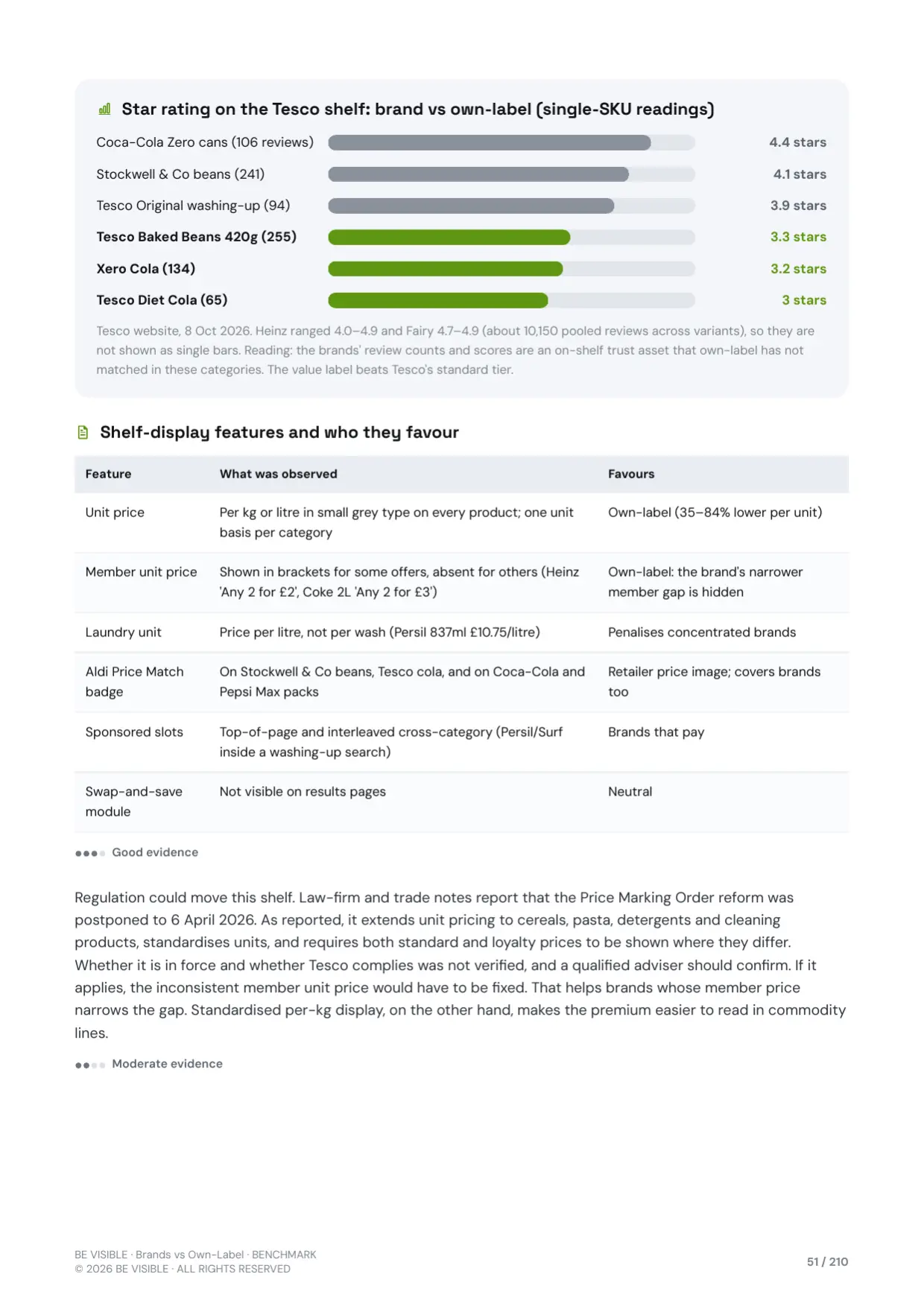
The shelf's design adds to the picture. Unit price appears in small grey type on every product, which favours own label, and the member unit price is shown for some offers and absent for others. For laundry the unit is the litre, not the wash, which penalises concentrated brands.
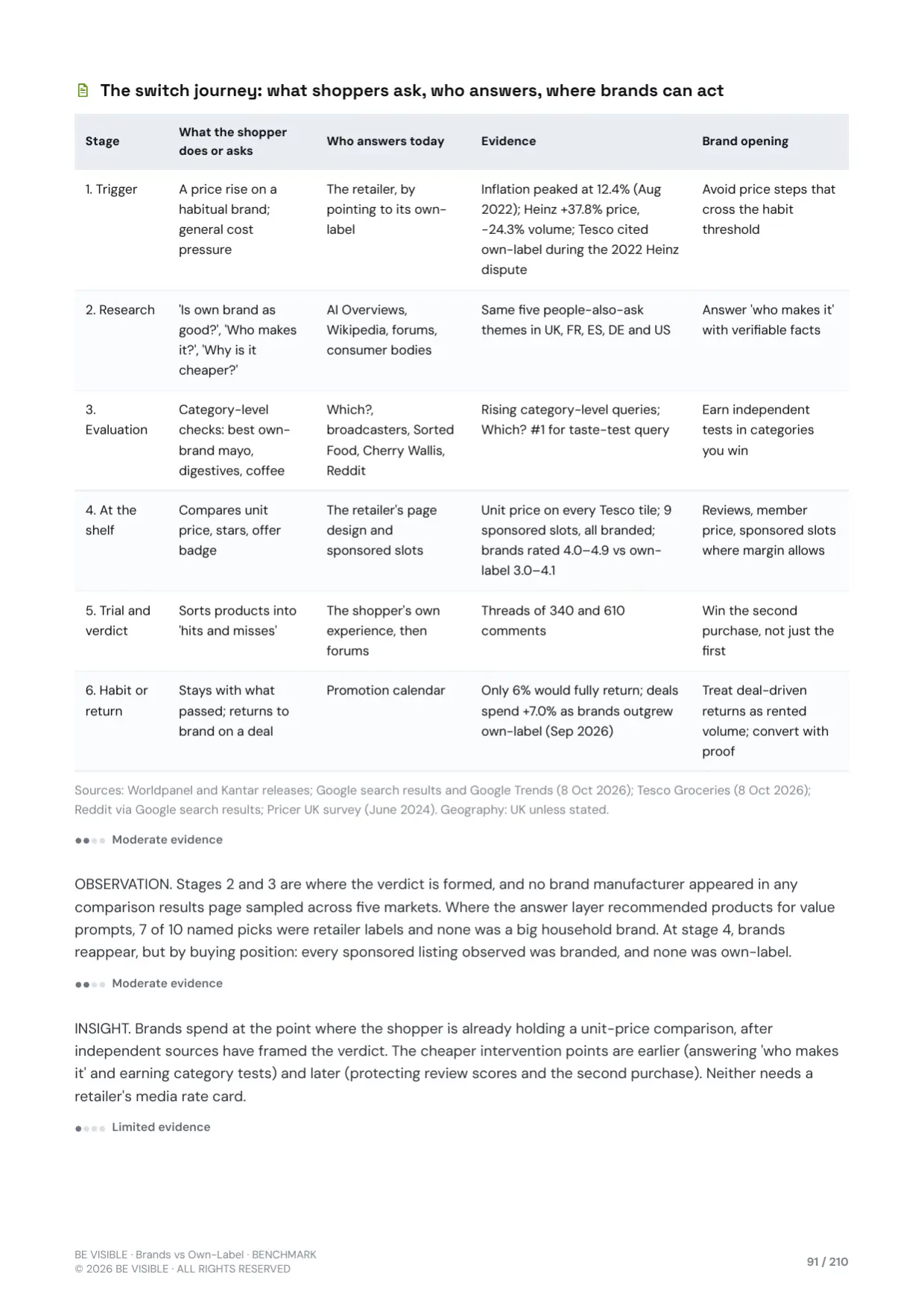
Off the shelf, the verdict is written elsewhere. 'Supermarket own brand' averages 0 in UK search interest, against 49 for the generic 'dupes', and the dupes family is led by beauty, not grocery. In the five markets sampled, no brand manufacturer appeared on a comparison results page: publishers, broadcasters, consumer bodies and forums owned them all. In the two Google AI Overviews captured, 7 of 10 named picks were retailer labels and no big household brand appeared, a directional count the report grades D.
Read together, the findings translate into plain website work:
- State the provable difference on the product page. The report finds shoppers doubt own label on consistency and performance, and that no brand owns the question 'who makes it' in any of the five markets. A page that shows what is different, with the specification or test result, answers it before a third party does.
- Show unit price and cost per use yourself. Retailer shelves show per-kilo and per-litre prices in small grey type, and per litre for laundry rather than per wash. The report lists cost per wash among the visible proofs a brand can offer.
- Treat reviews as an asset to protect. The report advises prompting reviews after promotions, not only at launch, and building review volume in the first 90 days of a listing before buying sponsored slots. A website's post-purchase flow can ask.
- Publish independent proof and skip the dupes. AI answers draw on independent tests such as Which? and Good Housekeeping, and the report says a brand's own site content alone will not get it cited. It rejects dupes as a grocery keyword territory.
What to watch next
The report's trend scan names four forces for the next two years: own label moving upmarket, retailers' health ranges, GLP-1 baskets and promotion intensity. Regulation works on promotion and price transparency, not on listing fees. HFSS rules in England restricted volume promotions and prominent placement from 1 October 2025, and paid online advertising for less healthy products from 5 January 2026, narrowing the deep-promotion route brands use to buy share back. France caps food promotions at 34% of value and 25% of volume.
The report's leading indicators include Lidl's share rising by more than 0.5 points year on year, a second retailer licensing a brand after Morrisons, and whether the branded rebound survives once promotions normalise. The Thatchers v Aldi appeal, decided on 20 January 2025, leaves the bigger risk for a challenger as a copied claim or category, not a copied pack.
The report's limits
The report grades its own evidence plainly. The share evidence is decision-grade (B), while the shelf-price, channel and AI evidence is a pilot. It collected about 45 shelf-price rows (about 28 UK) against a target of 150+ (80+ UK), audited one of six targeted UK retailers online, and captured two Google AI Overviews, with ChatGPT, Perplexity, Claude and Copilot not testable. No 2026 panel figure exists for premium own-label growth, and the Pricer survey is a vendor's measure of stated intent.
It also logs contradictions. Independent press and AI answers mostly declare own label the winner, while shoppers rating products on the retailer's own shelf rate brands higher in every category sampled, which the report puts down to blind, price-framed tests against repeated use. Its case evidence has fewer than three dated cases per route. Beyond this article, the report goes on to apply a compete, co-exist or supply rule category by category, with a 90-day plan and KPIs.
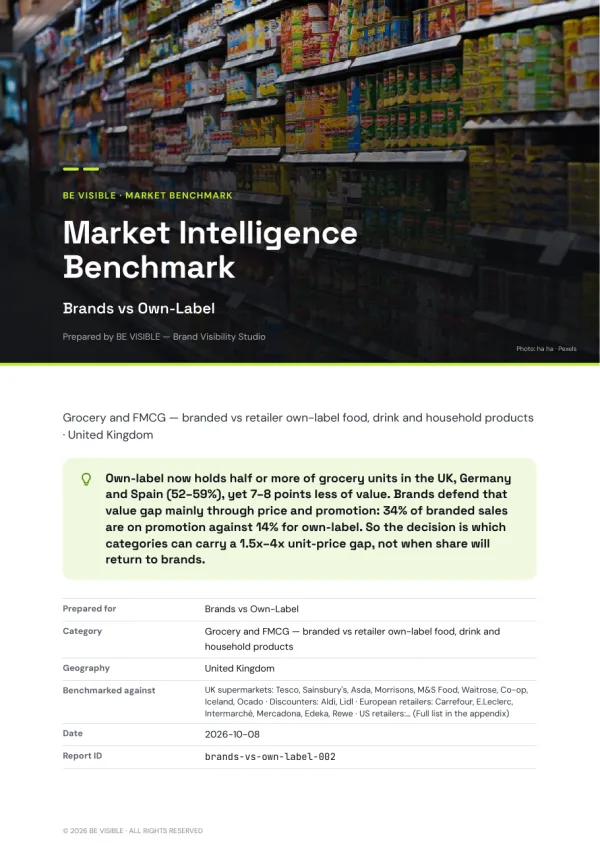
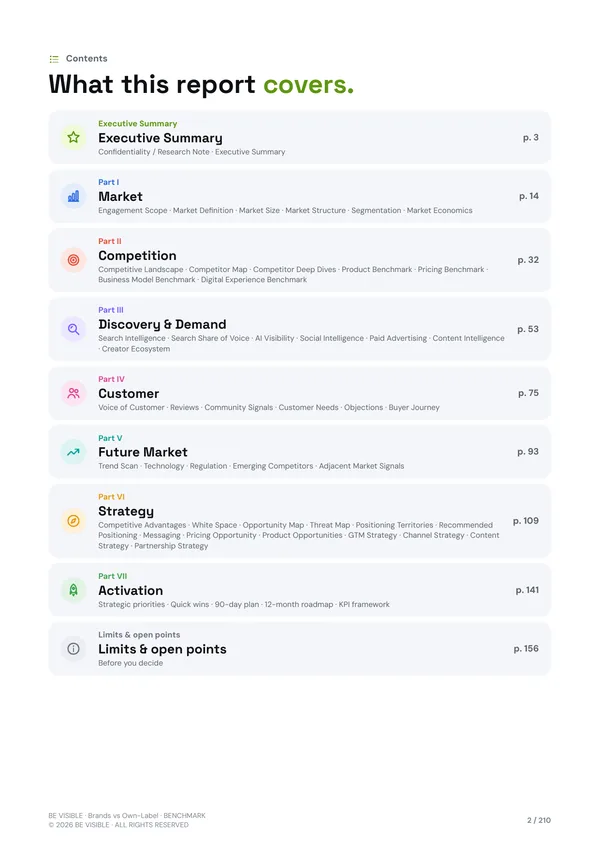
The full report is a designed PDF, in English. Buy it below, or see every report.
Written by
BE VISIBLE Studio
Website studio
READ THE FULL REPORT.
Brands vs Own Label: a 210-page PDF report, in English. Or choose 5 reports for $399.